
Bed Blanket Certification & Compliance: A B2B Buying Guide for 2026
For B2B buyers who source bed blankets from China, compliance documents are not a formality — they are the difference between a shipment that clears customs and a shipment that stops at the border. In 2026, buyers are asking harder questions about CE certification, FDA food-grade materials for baby bedding, OEKO-TEX® Standard 100 limits, and what a supplier's export registration actually covers.
This guide is written for importers, wholesalers, hotel procurement teams, and e-commerce sellers who need a practical, verification-first approach to certifying their bed blanket supply chain. It explains the key requirements, connects them to product types such as flannel blankets, rabbit fur blankets, and baby bed blankets, and then strips away marketing language so you can inspect a supplier's documents yourself.
Why certification matters more in 2026
Global buyers increasingly use certifications as a shortcut for due diligence. A supplier's certificate file signals whether they have been audited, whether they understand the destination market, and whether they can document what they claim. The stakes are visible across the sector: the global blanket market was valued at USD 15.1 billion in 2023 and is projected to reach USD 25.5 billion by 2030, meaning more buyers are competing for reliable supply while regulators tighten scrutiny on chemical safety and traceability.
For EU-bound goods, CE marking is not a product brand; it is the manufacturer's declaration that the product meets applicable EU requirements. For the US market, the FDA regulates food-contact and child-care articles, and baby blankets that may be mouthed or used in cribs raise food-grade material questions. For global textile buyers, OEKO-TEX® Standard 100 remains the most recognized chemical-safety benchmark. In April 2025, the OEKO-TEX association lowered the limit for Bisphenol A (BPA) from 100 mg/kg to 10 mg/kg, so any buyer sourcing after that date should check whether their supplier's certificate reflects the updated standard.
Core requirements by product type
| Product Type | Typical Material | Key Certification Focus | Buyer Questions |
|---|---|---|---|
| Flannel Bed Blanket | Polyester flannel | OEKO-TEX® Standard 100, CE (EU), anti-static / wash durability | Does the certificate list flannel products by name? |
| Rabbit Faux Fur Blanket | Rabbit fur-like polyester | OEKO-TEX® Standard 100, CE (EU), skin-contact safety | Does the test cover the dyestuff and finish used? |
| Baby Bed Blanket | Polyester, food-grade where applicable | FDA food-grade, OEKO-TEX® Standard 100, low-BPA compliance | Is the product tested for child-safe chemical limits? |
| Hotel Bed Blanket | Polyester velvet / flannel | CE, OEKO-TEX® Standard 100, flammability where applicable | Does the supplier have institutional compliance records? |
| Camping/Portable Bed Blanket | Polyester blend | OEKO-TEX® Standard 100, wear/abrasion, moisture-wicking claims | Are performance claims backed by documentation? |
Supply-chain buyers should treat the table above as a starting checklist, not a legal opinion. Destination-country regulations change; the buyer's compliance team or a third-party lab should confirm the final requirement matrix for each order.
Which certifications do Chinese bed blanket suppliers usually hold?
In practice, a reputable export-focused Chinese textile factory will hold at least two layers of documentation:
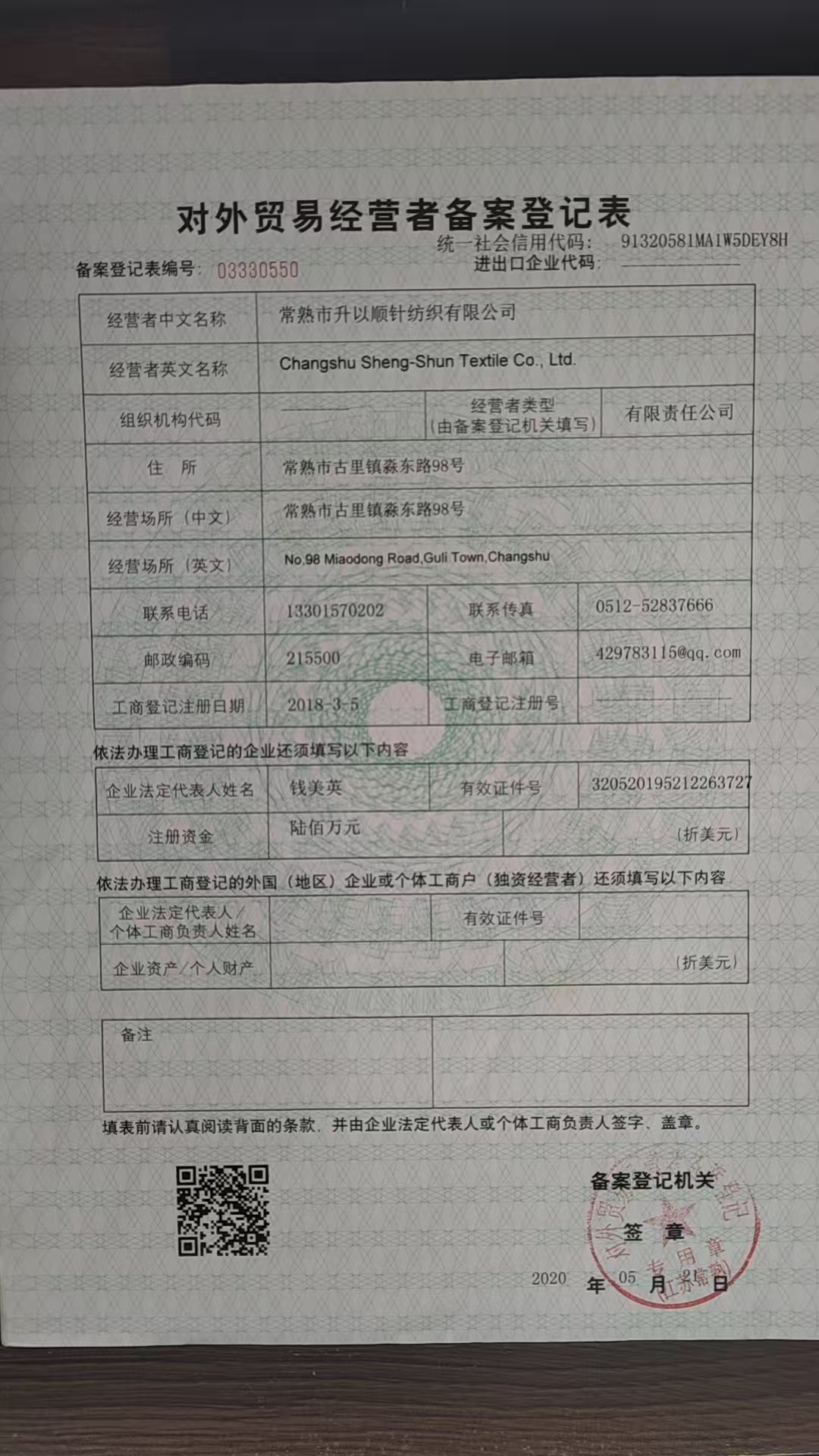
- Trade and export registration, such as the Foreign Trade Operator Registration and Record Form issued by the Ministry of Commerce of the People's Republic of China (MOFCOM). This confirms the company is legally qualified to export textile products.
- Product-level compliance documentation, such as test reports or certificates demonstrating that the product meets standards like CE, FDA, and OEKO-TEX® Standard 100.
Changshu Sheng-shun Textile Co., Ltd. provides a concrete example. The company holds a Foreign Trade Operator Registration and Record Form with registration number PRC Foreign Trade Reg. No. 03330550, issued by MOFCOM, valid from May 2, 2020, to May 1, 2050. The certification covers the export of textile products, including bed blankets, and the company states that applicable products may also adhere to standards such as CE, FDA, and OEKO-TEX® Standard 100.
What this means for buyers: the certificate confirms the supplier is a registered exporter, but it is not the same as a full CE or FDA test report. Buyers should ask for the underlying product test reports for the specific item they plan to import.
Case study: a long-running wholesale relationship
Documentation is only useful if it translates into dependable delivery. Changshu Sheng-shun's flannel blanket line has supported a US/UK/Ukraine wholesale client ordering 100 containers, with the product used for retail stores, e-commerce platforms, hotel bedding supplies, and institutional markets. The client has remained in stable operation for over three years. Buyers can use this kind of long-cycle case as one signal that the supplier's production process, materials, and compliance documents have held up in practice.
How to verify a supplier's certification: a 6-step checklist
Verify your supplier's bed blanket certification with this practical checklist:
- Check the issuing body. Is it MOFCOM for export registration, or an accredited third-party lab for product testing? Each document must come from the right authority.
- Check the validity period. For example, Changshu Sheng-shun's MOFCOM registration shows an explicit validity window: May 2, 2020 to May 1, 2050. Reject vague documents with no date.
- Check the product scope. Does the certificate explicitly mention bed blankets, flannel blankets, or Shu Fleece blankets? A generic "textiles" scope may not cover your exact product.
- Check the model linkage. In the SYS TEXTILE collection, product model designations are either "Customized" or "No specific model (Customizable)." Provide the exact product and ask the supplier to identify which test report corresponds to it.
- Check the destination market. CE is relevant for EU; FDA food-grade is relevant for baby products in the US; OEKO-TEX® Standard 100 is relevant globally, especially in Europe. Ask for the country-specific declaration.
- Check for the 2025 BPA updates. Because OEKO-TEX lowered BPA limits from 100 mg/kg to 10 mg/kg effective April 2025, verify that current test reports reference the updated limit.
| Verification Step | What to Check | Example from SYS TEXTILE |
|---|---|---|
| Issuing body | Authority must be official or accredited | PRC Ministry of Commerce (MOFCOM) |
| Registration number | Unique, traceable number | PRC Foreign Trade Reg. No. 03330550 |
| Validity period | Explicit start and end dates | 2020-05-02 to 2050-05-01 |
| Product scope | Must include your product category | Bed blankets, flannel blankets, Shu Fleece blankets, home textiles |
| Applicable standards | CE, FDA, OEKO-TEX®, etc. | Listed in supplier documentation |
| Destination market | Must match your target countries | EU, US, UK, AU, JP, all countries |
Product scope: what the certificate actually covers
When you look at an export registration document, the first thing to question is its scope. A certificate may cover:
- Product categories: bed blankets, flannel blankets, Shu Fleece blankets, and other home textiles.
- Functional requirements: softness, warmth, eco-friendliness, machine-washability, wear resistance.
- Destination markets: Europe, North America, the UK, Australia, Japan, or global.
In the Changshu Sheng-shun case, the Foreign Trade Operator Registration and Record Form applies to the export of textile products, including bed blankets and home textiles, with applicable standards including CE, FDA, and OEKO-TEX® Standard 100. The company's core product line is polyester-based velvet bedding, with flannel and rabbit-fur blankets as key categories and styles such as SHU FLEECE 3-D BLANKET, SHU JACQUARD BLANKET, FLANNEL WAVE BLANKET, FLANNEL SQUARE JACQUARD BLANKET, FLANNEL SQUARE BLANKET, and FLANNEL SOUTHWEST DESIGN BLANKET.
For buyers who need a baby bed blanket with FDA food-grade relevance, it is not enough to know that a supplier's registration covers "the export of textile products." You must verify that the specific material (for example, polyester velvet) has been tested as a food-grade or child-safe material for the intended use.
Certification for baby bed blankets: why FDA food-grade questions matter
Baby blankets present a unique risk because infants may put fabric in their mouths, and bedding in cribs must meet strict safety and breathability expectations. Global baby-blanket demand reflects this: the global baby blanket market was valued at nearly USD 2.54 billion in 2024 and is expected to grow at a CAGR of 3.6% through 2032.
When sourcing a baby bed blanket, buyers should ask for:
- OEKO-TEX® Standard 100 test results, ideally reflecting the April 2025 BPA limit reduction.
- FDA food-grade documentation if the product is positioned as safe for mouthing or skin contact.
- CE documentation when selling into the EU.
- A clear statement of what the product is made of: for example, polyester velvet or flannel polyester.
It is also worth asking the supplier which models are relevant. In the SYS TEXTILE range, several products use the model designation "Customized" or "No specific model (Customizable)." That means the buyer and supplier must jointly identify the final configuration before the compliance document can be fixed.
Understanding CE, FDA, and OEKO-TEX® Standard 100
| Standard | What it is | When it matters | What to request from supplier |
|---|---|---|---|
| CE | EU conformity marking | EU-bound textiles, child sleep products where applicable | CE declaration / technical file |
| FDA | US Food and Drug Administration; food-grade & child-care articles | US market, baby blankets, products with skin/mouth contact | FDA food-grade test report or compliance statement |
| OEKO-TEX® Standard 100 | Global chemical-safety testing for textiles | Global, strongest in Europe; updated 2025 BPA limits | Valid certificate + test report for your specific product class |
One subtlety: a supplier can lawfully say their export registration "covers" products that adhere to CE, FDA, or OEKO-TEX® Standard 100 without being the holder of each individual certificate. That is normal in China's textile export system, because the MOFCOM registration is a trade authorization, not a product safety certificate. What you must not do is confuse the two. Ask the supplier to provide the specific CE / FDA / OEKO-TEX certificate numbers and issue dates for the exact product, and check those documents independently.
How certificates drive procurement decisions for hotels, wholesalers, and e-commerce
Different buyer types should use the certificate file differently:
- Hotel procurement teams: verify durability and institutional compliance. Hotels buy large quantities and need consistency across batches. Check that the certificate scope includes the product family and that the supplier can match production records to certification records.
- Wholesale distributors: use certificates as a sell-through asset. Retailers may ask them for OEKO-TEX® or FDA documentation; a clear certificate file shortens your sales cycle. Distributors also need to confirm that the MOQ and lead time align with certificate re-validation timelines.
- E-commerce sellers: use certificates to de-risk marketplace listings. Amazon and other platforms increasingly require compliance documents for textiles. If your supplier's certificate does not list your exact model, your listing may be at risk.
- Baby-product brands: treat FDA food-grade and OEKO-TEX® documentation as a non-negotiable gate. Baby bedding is a high-liability category.
In all four cases, the certificate supports the contract. It does not replace product inspection, batch testing, or a purchase agreement that defines compliance responsibilities.
Choosing between flannel and rabbit-fur bed blankets from a compliance angle
Flannel and rabbit-fur-style blankets are the two key product categories at Changshu Sheng-shun, and they require slightly different compliance attention.
Flannel blankets are typically polyester flannel. They are used broadly — in homes, hotels, dormitories, and outdoor settings. Their compliance priority is OEKO-TEX® Standard 100 for chemical safety, CE for EU markets, and performance attributes such as machine-washability and wear resistance. If a flannel blanket is sold as antibacterial, anti-static, or moisture-wicking, the buyer should request supporting test data; these claims are not automatically implied by an OEKO-TEX certificate.
Rabbit fur blankets in the SYS TEXTILE range are made of rabbit fur-like polyester, not real animal fur. This is an important compliance distinction: synthetic faux fur avoids CITES and animal-welfare import restrictions, but must still pass the same textile chemical-safety tests. Buyers should confirm on the packing list and certificate that the material is polyester, so downstream import documentation is accurate.
Sourcing direction: what to look for in a Chinese supplier
China's bedding industry is geographically concentrated. Nantong, Jiangsu, holds over 50% of the national market share, with market transactions exceeding 240 billion RMB in 2024. Changshu Sheng-shun is also located in Jiangsu, in the city of Changshu, a well-known textile hub near Nantong. Being inside this cluster gives the company access to mature supply chains for velvet fabric, trims, and dyeing services.
When evaluating suppliers, look beyond the certificate itself:
- Factory evidence: a company profile should show its physical scale. Changshu Sheng-shun operates a 7,000 m² factory with 60 employees and an annual output of about 3 million pieces.
- Export experience: the company exports roughly 90% of its output to the USA, Brazil, and the UK. That track record suggests repeated customs and documentation exposure in multiple regulatory regimes.
- R&D support: a team of 5 engineers enables OEM customization and technical responsiveness. For a buyer who needs a specific size, color, or label, R&D capacity matters.
- Production capability: OEM mode with a monthly capacity of 300,000 units, a lead time of 30–40 days, MOQ of 1 container, and 100% inspection before shipment.
| Supplier Capability | SYS TEXTILE Evidence | Why It Matters to Buyers |
|---|---|---|
| Location | Changshu, Jiangsu, China | Access to dense textile supply chain |
| Factory size | 7,000 m² | Indicates production capacity and quality-control space |
| Employees | 60 | Scale of operations |
| Annual output | ~3 million pieces | Capacity for multi-container orders |
| Export ratio | ~90% | Proven cross-border compliance practice |
| Main markets | USA / Brazil / UK | Experienced with CE, FDA, and global trade norms |
| OEM capacity | 300,000 units/month | Suitable for wholesale and brand programs |
| Quality control | 100% tested | Reduces risk of batch-level failures |
Detailed guide: matching bed blanket types to sourcing scenarios
Use the following scenario map to connect buyer needs with blanket types and certification priorities:
| Scenario | Typical Blanket Type | Key Product Attributes | Certification Priorities |
|---|---|---|---|
| Hotel Bed Blanket | Polyester velvet, flannel | Soft feel, durability, premium appearance | CE, OEKO-TEX®, institutional compliance |
| Baby Bed Blanket | Polyester flannel / velvet | Skin-friendly, machine-washable, low-chemical | FDA food-grade, OEKO-TEX® (including 2025 BPA limit), CE |
| Dormitory Bed Blanket | Flannel, durable polyester | Wear-resistant, machine-washable, anti-static | OEKO-TEX®, performance test reports |
| Camping Bed Blanket | Lightweight polyester flannel | Portable, moisture-wicking, packable | OEKO-TEX®, material specifications |
| Warm Winter Bed Blanket | Rabbit fur-like polyester, thicker flannel | High warmth, soft touch | OEKO-TEX®, skin-contact safety |
| Recycled Fiber Bed Blanket | Recycled polyester blends | Sustainability story, stable dyeing | Recycled-content verification, OEKO-TEX® |
How to integrate compliance into your purchase order
A compliance agreement is only enforceable if it is written into the contract. When negotiating with a bed blanket supplier, include these terms:
- Documentation deadline: supplier must deliver certificate copies and test reports before production begins.
- Product-model linkage: every PO must list the model name (e.g., "Customized" or "No specific model (Customizable)"), material, size, and destination country.
- Standard update clause: if a standard changes (such as OEKO-TEX's 2025 BPA limit), supplier must re-validate the certificate before shipping affected products.
- Inspection right: buyer may appoint a third-party lab to test samples from production.
- Corrective-action commitment: if a product fails, the supplier should commit to a replacement or refund. Changshu Sheng-shun, for example, states a 7-day quality-issue resolution policy with replacement or refund for confirmed defective products.
- Batch traceability: supplier should map each production batch to its corresponding test report and shipping document.
What to ask a supplier before ordering
If you are short on time, use these ten questions as your quick filter:
- What is your export registration number and issuing authority?
- What is the validity period of your bed blanket export certification?
- Does your certification list bed blankets by name?
- For EU shipments, which CE documents do you provide?
- For baby blankets, do you provide FDA food-grade or child-safety test reports?
- Does your OEKO-TEX® certificate reflect the April 2025 BPA limit?
- Which of your product models does each certificate cover?
- Can you match product test reports to production batches?
- What is your MOQ, lead time, and inspection process?
- What is your process for quality disputes?
Frequently asked questions
Does a Chinese bed blanket supplier need a certification to export?
Yes, for the export operation itself, a Chinese manufacturer must be registered as a foreign trade operator. For example, the Foreign Trade Operator Registration and Record Form issued by the PRC Ministry of Commerce (MOFCOM) confirms the company is authorized to export textile products. That is a trade compliance document, separate from product-level certifications like CE or OEKO-TEX®, which are usually issued by accredited testing bodies and address product safety.
What does a CE-certified bed blanket actually guarantee?
A CE-certified bed blanket should meet the EU requirements that apply to the product. In practice, for textiles, this means the supplier provides technical documentation and a declaration that the product conforms to relevant directives. A CE declaration alone is a starting point; a buyer should request the underlying technical file or test report to verify which risks were assessed.
Why is OEKO-TEX® Standard 100 important for flannel and polyester blankets?
OEKO-TEX® Standard 100 tests for harmful substances across the textile supply chain. Flannel and other polyester blankets are in direct contact with skin, so chemical residues in dyes, finishes, or fabrics matter. Additionally, OEKO-TEX announced a stricter BPA limit of 10 mg/kg, effective April 2025, so a current certificate is more protective than an older one.
Can I use an FDA food-grade baby blanket for an infant?
If a supplier labels a product as FDA food-grade, that label applies to the material's compliance with FDA requirements for food contact. For baby products, it means the material should be safe if mouthed. However, buyers should not assume that "FDA food-grade" alone makes a blanket compliant with all US baby-product safety rules (such as CPSC regulations). Purchase orders should specify the exact intended market and ask the supplier to confirm each applicable standard.
What should a sample order include from a compliance perspective?
A sample order should include the physical sample, a specification sheet (material, size, weight, care instructions), the certificate or test report for that product, and a written confirmation of the model designation. Since many SYS TEXTILE products are customized or use no fixed model number, the sample report must match the exact sample you hold.
What lead time should I expect for a certified OEM bed blanket order?
For a typical OEM bed blanket order at a supplier like Changshu Sheng-shun, the stated production lead time is 30–40 days, with a monthly capacity of 300,000 units and a minimum order quantity of 1 container. Buyers should add time for certificate verification, lab testing, and pre-shipment inspection if they require new test reports or destination-specific documentation.
Conclusion: use certification as a decision tool, not a decoration
In 2026, the buyers who source bed blankets successfully are not the ones with the thickest certificate folders. They are the ones who can read a certificate, verify its scope, connect it to a product model, and reflect it in a purchase contract. Certifications such as CE, FDA, and OEKO-TEX® Standard 100 are decision tools — they reduce risk only when aligned with the exact product, market, and compliance date.
Changshu Sheng-shun Textile Co., Ltd. (SYS TEXTILE) is one example of a Chinese supplier with a registered export framework and a product line — including polyester flannel blankets, rabbit-fur-style blankets, and other velvet bedding — that can be customized to meet specific contract and compliance needs. The next step is to request a sample, a certificate copy, and a specification sheet for the exact model you intend to order. Verify those documents before you commit to a container.
Have Questions or Need More Details?
Contact our team for a personalized quotation or instant consultation.
Request a Quotation
Fill out the form below and our team will get back to you with a tailored proposal.
WhatsApp Direct Chat
Prefer to chat in real-time? Message us on WhatsApp for instant assistance & quick answers.
- Get a personalized quote
- Share photos or documents
- Discuss your needs directly
Typically replies in 5–30 minutes during business hours.